
In the evolving landscape of online search, Generative Engine Optimization (GEO) is emerging as the successor to traditional Search Engine Optimization (SEO). As Large Language Models (LLMs) like GPT-4o, Gemini, and Claude redefine how users access information, marketers must adapt to a new era where visibility hinges on AI-generated responses rather than page rankings.
The Evolution from SEO to GEO
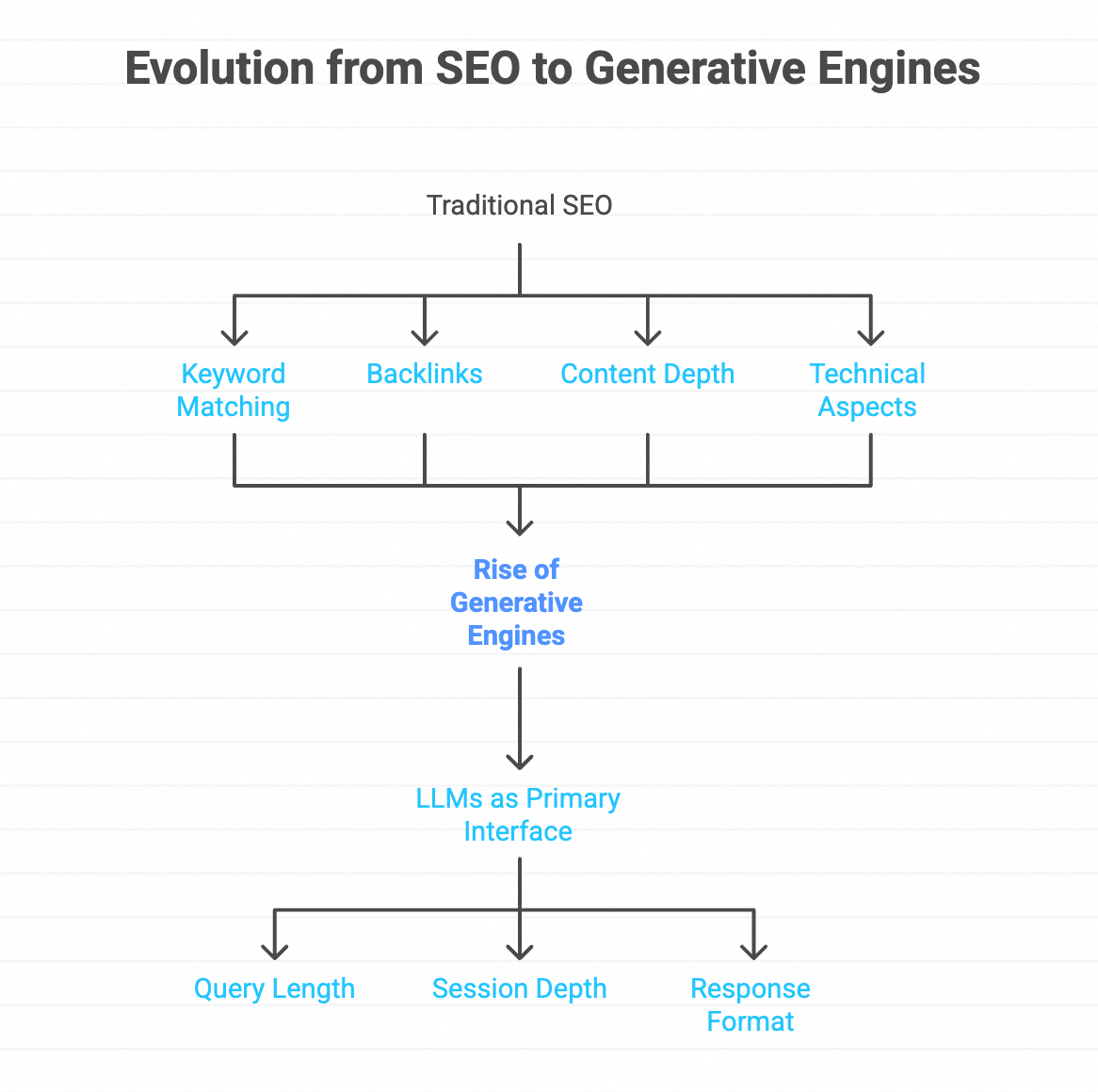
Traditional SEO focused on optimizing websites for search engines like Google, emphasizing factors such as:
- Keyword matching and density
- Backlinks from authoritative sites
- Content depth and user engagement metrics
- Technical aspects like site speed and mobile-friendliness
However, with the rise of generative engines, the game has changed. LLMs now serve as the primary interface for queries, synthesizing information from multiple sources into coherent, personalized answers. Key differences include:
- Query length: Average queries are now 23 words long, compared to 4 in traditional search.
- Session depth: Interactions last around 6 minutes, allowing for more contextual and iterative exchanges.
- Response format: Answers are synthesized, reasoned, and tailored, often drawing from diverse platforms like Instagram, Amazon, or Siri.
In summary, GEO prioritizes content that is structured, meaningful, and easily extractable by LLMs. Techniques such as using bullet points, clear summaries, and phrases like "in summary" enhance how models parse and reference material.
Business Model Shifts and Incentives in Generative Search
Unlike ad-driven search engines like Google, many LLMs operate on subscription models, reducing the emphasis on monetizing through external links. This impacts content surfacing:
- Incentives: Providers focus on user value, referencing third-party content only when it enhances the experience.
- Emerging metrics: Outbound clicks from platforms like ChatGPT indicate growing referral traffic to domains.
- Potential for ads: While an advertising ecosystem may develop, it will differ significantly from traditional search ads.
Brands must now optimize for reference rates—how frequently their content appears in AI outputs—rather than just click-through rates.
Measuring Success in the GEO Era
New tools are revolutionizing how brands track GEO performance. Platforms like Profound, Goodie, and Daydream offer:
- Synthetic query analysis: Running simulated prompts to monitor brand mentions.
- Sentiment tracking: Evaluating how LLMs portray brands across responses.
- Competitive insights: Dashboards for share of voice and messaging consistency.
Legacy tools are adapting too:
- Ahrefs' Brand Radar monitors mentions in AI Overviews.
- Semrush's AI toolkit helps optimize content for generative visibility.
For instance, Canada Goose leveraged these tools to assess unaided brand awareness in LLM outputs, focusing on spontaneous mentions rather than direct searches.
In essence, GEO strategy now includes managing "model perception"—how brands are encoded in AI systems—as a core competitive edge.
Drawing Lessons from SEO's Fragmented History
The SEO industry, valued at over $80 billion, remained decentralized despite its scale. Key players like Semrush, Ahrefs, Moz, and Similarweb specialized in niches such as keyword research, backlink analysis, or traffic monitoring, but none dominated the full ecosystem.
Challenges included:
- Data access: Clickstream data was hard to obtain, locked behind proprietary sources.
- Fragmentation: Work was spread across agencies, freelancers, and internal teams.
- Algorithm opacity: Providers like Google controlled the rules, leading to constant adaptations.
GEO presents an opportunity to centralize this process, combining measurement with actionable infrastructure.
Building the Future: GEO Platforms and Opportunities
Winning GEO platforms will evolve beyond analytics into full-stack solutions:
- Fine-tuned models: Learning from vast prompt data to shape LLM behavior.
- Clickstream integration: Merging first- and third-party data for accurate insights.
- Operational tools: Real-time campaign generation, model memory optimization, and iterative feedback loops.
This positions GEO as a gateway to broader performance marketing, enabling autonomous, AI-driven strategies across channels. As search behaviors shift in 2025—with integrations like Perplexity and Claude in Safari—brands that master GEO will secure their place in the "model's mind."
In summary, the transition to Generative Engine Optimization isn't just about visibility; it's about forging lasting relevance in an AI-dominated world. Marketers who embrace structured content, keyword-rich narratives, and advanced tools will thrive in this new paradigm.